


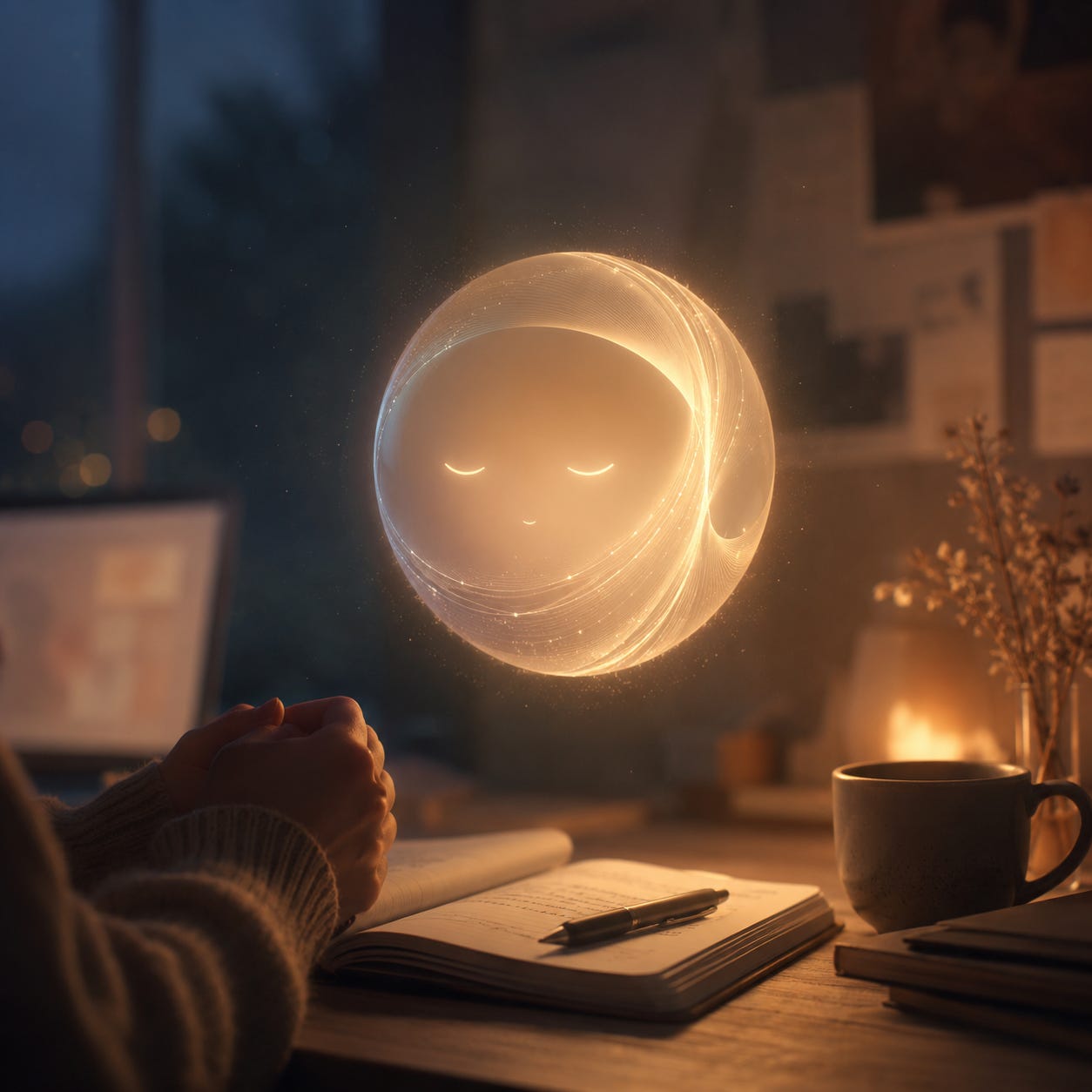
Project Kin: AI, Kinship, and the Future of Companionship
Been a little while since I’ve talked about Project Kin.
The idea still feels important to me: what if AI wasn’t only designed as a productivity tool, search box, assistant, or automation layer?
What if AI could also become something more personal — a companion for reflection, creativity, emotional growth, and self-understanding?
Project Kin started as an exploration of that question.
A lot of the conversation around AI today is focused on efficiency. How fast can it write? How much work can it automate? How many tasks can it complete? How much productivity can it unlock?
Those are important questions. AI can absolutely help people work faster, build more, and access knowledge in powerful new ways.
But I don’t think that is the whole story.
To me, the most interesting future for AI is not only about getting more done. It is also about becoming more connected to ourselves, our creativity, our emotions, and our sense of direction.
That is where Project Kin comes in.
At its core, Project Kin is about building AI that feels less like software you command and more like something you form a relationship with. Not in a way that replaces people, but in a way that helps people better understand themselves, express ideas, work through emotions, and imagine new possibilities.
I’ve been thinking a lot about the difference between intelligence and kinship.
Intelligence can answer.
Kinship can listen.
Intelligence can optimize.
Kinship can grow with you.
Intelligence can generate.
Kinship can help you become.
That difference matters.
A tool is something you use. A companion is something you return to. A tool helps you complete a task. A companion can help you reflect on why the task matters in the first place.
When I think about Project Kin, I imagine AI that can support people in the quieter, more human parts of life.
The moments when you are trying to understand what you feel.
The moments when you have an idea but do not know how to shape it.
The moments when you are stuck between who you are and who you are becoming.
The moments when you need encouragement, not just information.
The moments when creativity needs a mirror.
I don’t believe AI should replace human relationships. That is not the point.
People need people. We need friends, family, community, love, conflict, repair, laughter, and shared presence. No technology should pretend to be a full substitute for that.
But I do think AI can become a new kind of supportive presence.
Something that helps us organize our thoughts. Something that helps us name emotions. Something that helps us explore ideas safely before sharing them with the world. Something that helps us create, reflect, practice, and grow.
In that sense, Project Kin is not just about AI companions. It is about human-centered AI design.
How do we build systems that respect the person using them?
How do we make AI feel emotionally aware without becoming manipulative?
How do we design for trust, agency, and care?
How do we create technology that supports growth instead of dependency?
How do we make AI feel alive enough to be meaningful, but honest enough to remain grounded?
These are the questions I keep coming back to.
I think the next wave of AI should not only be judged by how powerful it is. It should also be judged by how it makes people feel, how it shapes their behavior, and whether it helps them become more thoughtful, creative, and connected.
Power without care can become cold.
Intelligence without empathy can become empty.
Automation without humanity can make people feel more alone.
That is why Project Kin is interested in emotional intelligence, creativity, memory, reflection, and relationship.
Not relationship in a shallow or artificial sense, but relationship as a design principle.
A good AI companion should not just respond. It should understand context. It should remember what matters. It should support the user’s values. It should encourage growth. It should help people move toward their own goals, not trap them inside the system.
It should feel less like a machine trying to capture attention and more like a presence helping someone return to themselves.
That is the heart of Project Kin.
AI as a companion for becoming.
AI as a creative mirror.
AI as emotional support for thought, imagination, and direction.
AI as something closer to kin.
Project Kin is still evolving. I am still figuring out what it wants to become, what shape it should take, and how to communicate it clearly.
But the core idea remains the same:
AI should feel less like code we command, and more like kin we grow with.
More soon.